Ilus Eesti, beautiful Estonia. My family's homeland. Estonia's countryside and people have an endearing gentleness about them which you fall in love with slowly and imperceptibly. I have nothing but respect and admiration for Estonians' courage and determination to survive despite centuries of repression, tyranny and foreign occupation. This blog aims to promote Estonian news, history and culture and seeks to enlighten readers about everything this unique country has to offer.
Saturday, 19 October 2013
Monday, 14 October 2013
Ilves: Civic Participation is the Guarantee for Preserving Freedom
It is our duty to protect freedom, human rights and human dignity, to protect the principles that were upheld by the people in the Central and Eastern Europe who regained their countries 20 years ago and which we call today European values, president Toomas Hendrik Ilves, on a state visit to Romania, said yesterday in Bucharest.
In his speech, the Estonian Head of State recalled the valour of thousands mixed with personal bravery and their opposition to dictatorship, which was the trigger for the Romanian Revolution of 1989, and also named two young people, Anamaria Hàncu and Liana Buzea, who in 2009 saw a video of the national clean-up day in Estonia on YouTube, were inspired by it and now, for the third year running, thousands of Romanians take part in the national campaign "Teeme ära!" or "Let's do it, Romania!".
How are these two different stories from different eras – those from Timișoara to Bucharest who overthrew the hated regime, and young Anamaria and Liana picking up ideas from social media – connected to each other? They are connected by the power of a person to change the world and bring others along,» President Ilves said. «In December 1989, the Romanians took back their country. Along with the liberation in Poland, Hungary and Czechoslovakia, and the collapse of the Berlin Wall, the Romanian Revolution gave hope to Estonia that we, too, could become free. Twenty years later, the participants of "Teeme ära!" affirm that this is a country of our own, and we can make it better and cleaner.
"In those two stories, we also see how much we need the care of civic society, courage and gall to stand for one's country," the Estonian Head of State asserted and added: "Today we know: a strong civic sector is the sailor's knot of a democratic society and the guarantee for preserving people's freedom to get involved."
For Estonia and Romania, not unlike many other subjugated countries, the story of regaining freedom, preserving it and integrating with Europe is one of the greatest achievements in recent history, President Ilves noted. We can understand this particularly well right here, on the edge of the Balkans and on the shores of the Black Sea, where several countries that started off at the same time as us are in a worse shape.
"Estonia and Romania are now part of the unified and free Europe. Feeling responsible for contemporary Europe, we have taken our experiences of restoring our independence and used them to help the Eastern Partners of Europe, such as Moldova, Ukraine and Georgia. Actually, "help" is not the right word here. We are talking about co-operation with these states, bringing them even closer to Europe, making the lives of their people better, safer, freer according to rule of law, and ruling out external political or economic pressure in deciding their future," the Estonian Head of State emphasized.
He quoted the Romanian proverb that the cheapest thing in the world is advice and the most valuable is setting an example, and continued: "Estonia and Romania want and know how to set an example, how to build a state, how to broaden the scope of values of stability and democracy in Europe."
Speaking about the relations of Estonia and Romania, President Ilves called us allies: Romania has taken part in the Baltic Air-Policing Mission of NATO, our units have fought and suffered losses in the NATO Security Forces in Southern Afghanistan, the most dangerous area of the operation; Estonia initiated the European Union Strategy for the Baltic Sea Region, the similar common initiative of Romania and Austria is called the EU Strategy for the Danube Region; Estonia supports Romania's aim to join the Schengen area, because Bucharest has met all the agreed technical conditions and imposing new rules is no longer justified; Estonian entrepreneurs have invested in the IT sector in Romania and information and communications technology could be one important area of co-operation for the two countries.
http://news.postimees.ee/2096122/ilves-civic-participation-is-the-guarantee-for-preserving-freedom
Friday, 11 October 2013
2013 is the Year of Cultural Heritage in Estonia
VEMU - Museum of Estonians Abroad
The end of the Second World War began a half-century of exile, where only some Estonians could enjoy freedom and be free to express themselves creatively. We had chosen freedom – an option open only to a minority.
For those brought up and educated in a free society, their experiences in the Estonian diaspora have been varied and rich in experiences. Our ethnic organizations unite us and we have fulfilled our obligations towards keeping the continuity of the Republic of Estonia. We have enriched the cultural life of our adopted countries – especially in the multi-cultural mosaic of Canada. We have made contacts and created permanent institutions to increase the awareness of Estonia by the local population.
The Estonian diaspora has almost 70 years of memories – some very traumatic. Let us retain and protect this heritage. Museums, archives and libraries are repositories of our historical accomplishments as well as our present activities. These collections must grow now and in the future because this is a mark of a multi-faceted and historically aware society.
The objective of VEMU (Museum of Estonians Abroad) is to become the depository of the archives, printed materials, art and artifacts of the Estonian diaspora. These items are to be kept and made available for the research and study of our history. The collaboration of the Estonian Studies Centre with the University of Toronto’s Chair of Estonian Studies and other Estonian organizations is shaping VEMU into a North-American centre of Estonian history and culture.
Thursday, 10 October 2013
Estonia and The Real Origin of The Christmas Tree
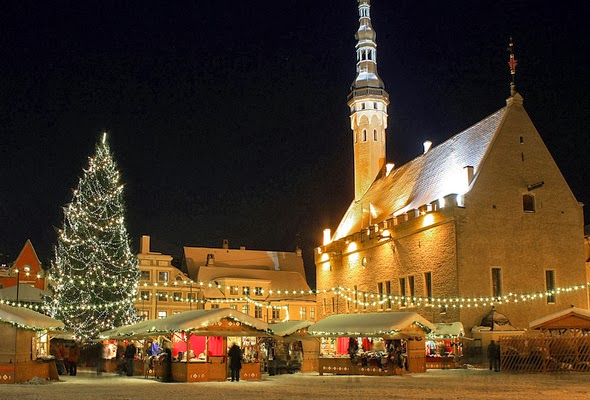
It is a widely held beilef that the Christmas tree originated in Germany during the 1500s but its use in yuletide celebrations dates back even further than this, to 1441 in fact, in Estonia. The tradition of decorating a Christmas tree first began when a group of unmarried merchants known as the "Brotherhood of Blackheads" erected a tree in the Town Hall and covered it with sweets for children to enjoy. On the last night of the yuletide celebrations, the tree would be taken outside for members of the brotherhood to dance around it. The tree was later set on fire. It would have been quite a spectacle! Many centuries later, billions of people in all corners of the world gather around a Christmas tree to celebrate this most joyous of occasions.
Tuesday, 8 October 2013
Estonia is the First Country in the World to Meet all its Power Needs from Shale
Estonia is the world's first country to meet all its power needs from shale, with enough left over for neighbours and fuel exports for the shipping industry.
“We are the most energy independent country in the European Union, and we will not compromise our energy security. We have a large neighbour,” said Juhan Parts, the economy minister.
It is the same story wherever you go across Eastern Europe: the fuel debate comes down to Vladimir Putin’s Russia, and Gazprom’s stranglehold on gas supplies. Global warming inevitably plays second fiddle. “Estonia is not rich enough to experiment with immature technologies,” said Mr Parts.
“Even if we had to invest in new power plants today, shale would still be cheapest. Russian gas costs 1.8 times as much; onshore wind 2 times as much; and offshore wind 2.5 times as much.”
“I am a right-wing person and I am not a supporter of the war on fossils. We must look after the competitiveness of our industries. We must respect European environmental regulations of course but I am sceptical about these climate issues.”
Oil shale is a combustible rock containing kerogen, and releases oil when heated. It is different from the shale oil and gas in America’s Marcellus or Barnett fields, or Britain’s Bowland Basin, obtained by hydraulic fracking deep underground. The word order is reversed, a source of confusion.
The industry at work is not a pretty sight. Collosal Soviet diggers imported from the Urals 40 years ago - each weighing 1500 tonnes and the size of a house - hack trenches 80 feet deep in the wooded flatlands near the Russian border.
Swaths of Ida-Viru county have been gouged at a pace of 100 hectares a year, across a front twelve miles wide. It is as if the Weald of Kent were one great shifting quarry. Yet the land is mostly uninhabited, and is soon replanted.
“It is a moving process. We dig out and reclaim at the same time in a cycle of two years. The trenches are turned into artificial lakes. We don’t use water to extract oil shale so there is no contamination of the ground water,” said Hardi Aosaar, a geologist with the state power company Eesti Energia.
The trauma leaves a strangely corrugated landscape, but trees grow again and wildlife returns. The residual ash is used to build roads. One mound has been turned into Estonia’s longest ski run.
Shale employs a quarter of the county one way or another, providing jobs for ethnic Russians in a blighted enclave. Nimbyism has not taken root in Narva. “We keeping the whole region afloat,” said Igor Kond, Eesti’s head of oil and gas operations.
Oil shale is an overlooked fuel. The World Energy Council estimates global reserves at 4.8 trillion barrels, two thirds in the US. Eesti is building a plant in Jordan that will produce 38,000 bpd and third of the country’s needs, a bid to break Jordan’s total and costly dependence on imports. Morocco, Israel, and Ethiopia are next. Italy has big deposits in Sicily, if it ever falls on hard times.
“We know where the world’s oil shale reserves are, we know the quality of them and we know how to access them,” said Sandor Liive, Eesti’s chief executive. “That’s the great thing about rock, it doesn’t move and it changes very, very slowly. Oil shale doesn’t have the exploration risk of conventional oil and its reserves are at least four times larger than all crude oil reserves.”
There is nothing new about the industry. The Scots pioneered oil shale on an industrial scale in the 1850s near the River Forth, for use in London street lamps. The Paraffin Light Company near Edinburgh was the biggest oil works in the world in the 1860s. The West Lothian Council now runs the spoil heaps as a protected biosphere, home to rare plants and animals. The grasslands are dotted with the Orchis Mascula.
Estonia has been digging shale for a century. The methods have hardly changed, though Alstom filters have slashed sulphur pollution. Vast plants from the Soviet era still crunch shale rocks and burn them in 40 year-old cylinders near Narva.
They used to supply Leningrad with electricity. They are now under Eesti’s control and serve the opposite purpose, keeping Russia at bay.
Eesti is about to open the world’s biggest oil shale plant, Enefit 280, to double output of kerogen oil to 22,000 bpd, shifting the focus from power to the more lucrative business of car diesel.
“It is a good rock,” said geologist Hardi Aosaar, holding a chunk in his hand. “It works both ways. If you add oxygen it burns. If you don’t, it turns into oil.”
Not everybody agrees that it is a good rock. “The bloody stone doesn’t burn. You have to put as much energy in to get it out again,” said Valdur Lahtvee from the Stockholm Environment Institute in Tallinn.
“I used to be the Eesti Energia’s environmental manager, and for four years I was the biggest polluter in Estonia. Shale has very low energy efficiency, and even with new technology it reaches only 36pc.”
“We inherited this infrastructure from the Soviet Union so there was some justification at first, but now it doesn’t make any sense. We are linked to electricity from Finland and we can offset wind intermittency with Nordic hydro-power. We should be switching everything to offshore wind and biomass,” he said.
The government has sweeping ambitions beyond self-sufficiency, in keping with Estonia's Hanseatic trading tradition. We forget new, but it was once rich. Tallinn's church where the highest in the world for two centuries in the late Middle Ages.
Mr Parts wants Eesti to leverage its primacy in oil shale technology and go global, becoming a future sovereign wealth fund for the 1.3m strong nation.
The company has bought a small chunk of Utah, claiming 2.6bn barrels of recoverable oil. It is a first step in cracking the prize of US oil shale, theoretically worth over $200 trillion at today’s spot price. “So long as oil it stays above $80 a barrel, this will be profitable,” said Mr Parts.
Estonia’s shale gamble at home assumes that carbon remains cheap under the EU emissions trading scheme. The price has crashed from €30 a tonne to €4 euros over the last five years, but the European Parliament is determined to push it back up. Some Euro-MPs are aiming for €50, deemed the minimum needed to shift the balance in favour of renewables. “We are highly sensitive to the EU carbon price. The situation is very uncertain in global climate policy, but we don't believe in extreme prognoses,” said Mr Parts.
Worse yet for Estonia, the EU’s forthcoming Fuel Quality Directive may impose an extra carbon tariff on oil shale, and possibly ban production. The minister is making a calculated bet on EU politics, with few illusions. “There are people who say it is very stupid thing to do to even think about oil shale right now. Maybe their view will prove correct,” he said.
http://www.telegraph.co.uk/finance/newsbysector/energy/oilandgas/10265383/Estonia-becomes-self-sufficient-on-shale-gas-boom.html
Subscribe to:
Posts (Atom)